OpenAI Developing Custom Chips With MediaTek Qualcomm for ‘AI Agent’ Smartphones: Ming-Chi Kuo
OpenAI reportedly is gearing up to build new custom processors for smartphones. The San Francisco-based artificial intelligence (AI) company has partnered with MediaTek and Qualcomm, which is said to be the most important chipmakers in terms of long-term demand for smartphones that have agentic AI capabilities gain traction, an analyst said. However, it is still considered to be in the ‘infancy stage’ phase of the project; mass production currently targeted for 2028 has been planned and mass manufacturing. The analyst said the supply chain is likely to include Luxshare as exclusive system co-design and manufacturing partner.
OpenAI’s Phone May Prioritise Power Efficiency, Memory Management
The TF Securities International analyst Ming-Chi Kuo writes in an X post that OpenAI’s ambitions are not just about chipmaking, the company is said to be exploring a wider push into AI-centric smartphones. If AI agent smartphones become a reality, the analyst said MediaTek and Qualcomm will likely benefit from long-term demand.
OpenAI Discussion
- OpenAI is reportedly developing a new system called Hermes
- OpenAI ChatGPT Images 2 | . This is where 0 will compete directly with Google Nano Banana 2 and it’s going to be here. Paraphrasing 0. Who would you say is b as the one of your thoughts on paraphrasing?
- Google Releases New AI Agents to Challenge OpenAI and Anthropic
- I keep hearing about AI inference? What exactly is this?
- ChatGPT Images 2.0 is out
Explore More…
According to alleged claims, the processor design should be more focused on power efficiency, memory management and on-device AI capabilities; while more complex tasks would be offloaded to cloud infrastructure. The said processor may be finalised by late 2026 or early 2027 with specifications and supply chain partners of its stated processor.
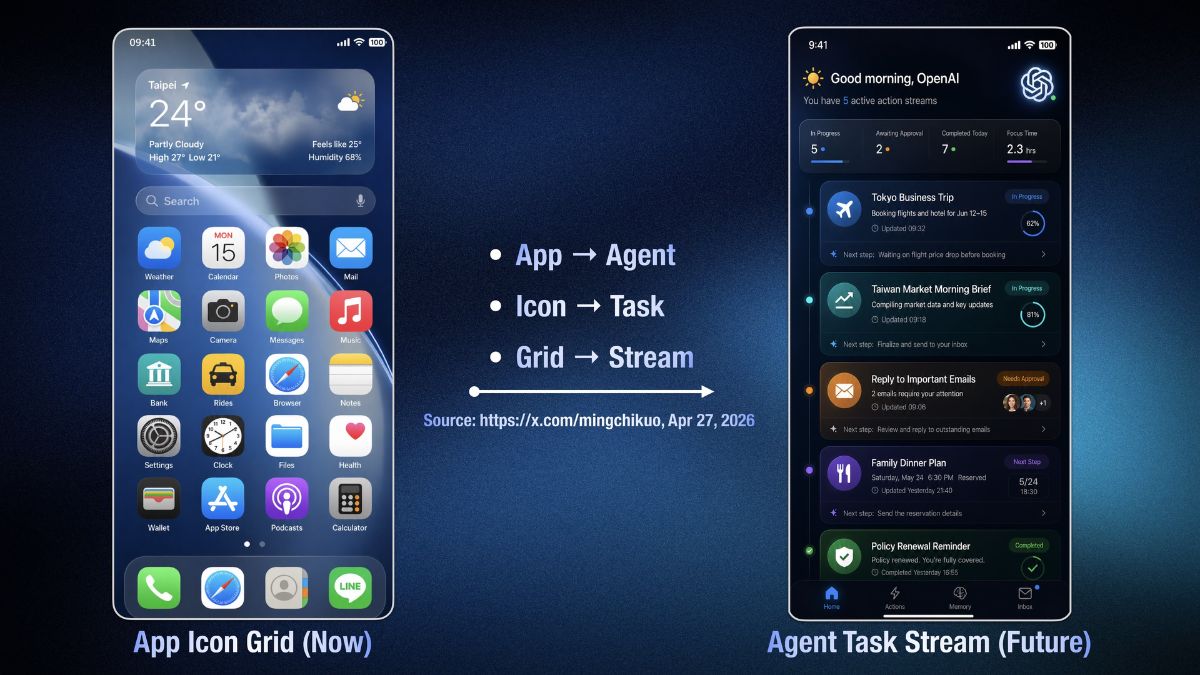
A conceptual smartphone interface to illustrate the potential evolution of the AI-driven experience, with iPhone as a reference point
Photo Credit: X/ Ming-Chi Kuo
This latest initiative, reportedly driven by the idea of an AI agent, is said to be driving behind OpenAI’s new program that could potentially lead to a change in how users interact with their devices. But they may use a single system that directly completes tasks, according to the analyst who has been using multiple apps instead of going through several applications. If this move is successful, it would mean a departure from the traditional ecosystems of apps towards more context-aware computing.
OpenAI sees the tighter integration of software, operating systems and physical hardware as essential to its long-term strategy, Kuo said. According to the company, it is “taking a high priority on hardware and software ecosystems” in order to provide an integrated AI agent experience. But smartphones are still the most critical device category for capturing the real-time user data needed to make effective AI inference,’ said analyst further.
A further analyst suggests that OpenAI could use its strengths in AI models, consumer brand recognition and accumulated data to create an ecosystem. Other than that, the AI firm could also explore bundling hardware using subscription based services.
Not only is OpenAI already announcing that it has been interested in chips and other AI-centric hardware development, but also its interest in chip development. In partnership with former Apple Chief Design Officer Jony Ive, it is believed to be developing an AI device. Also in 2025, the AI firm also announced a multi-year strategic partnership with Broadcom that would see the two companies design and develop chips and systems to support growing demand for AI compute.
Thanks for reading OpenAI Developing Custom Chips With MediaTek Qualcomm for ‘AI Agent’ Smartphones: Ming-Chi Kuo
